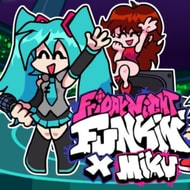
What happens when Friday Night Funkin’s four-key charting system — built for back-alley rap battles — has to keep pace with a full Vocaloid concert instead? That’s the premise behind Friday Night Funkin vs Hatsune Miku, a mod that swaps the usual boombox-and-porch backdrop for a stage, a crowd, and a pop idol who turns out to be Boyfriend’s own sister.
The Setup Behind Friday Night Funkin vs Hatsune Miku
The mod’s framing is simple: Boyfriend’s older sister has come home a famous singer, and the stage becomes the meeting point where she finally gets introduced to Girlfriend. It’s presented as only semi-canon within the wider modding scene, more of a fun nod than a serious addition to the base story, but it gives the whole week a reason to look like a concert instead of a street corner.
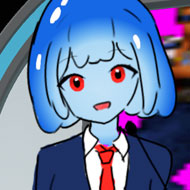
Hatsune Miku herself is rendered in a design based on her well-known V2 look, reanimated specifically for this mod rather than reusing stock art: cyan twin-tails, a black outfit with cyan trim, and a microphone she holds through most of her animations. The stage design leans into it too, with flashing lights and a crowd that reacts to the music instead of standing there like scenery.
One detail that regularly comes up when people describe the mod is the cameo from Tricky, the antagonist from the separate Tricky mod based on the Madness Combat series. During the main week he’s just part of the audience, glowstick in hand, watching the show — but on the bonus Ievan Polkka cover, he gets pulled up on stage to sing alongside Miku instead of standing in the crowd.
How Many Songs Does Friday Night Funkin vs Hatsune Miku Actually Have
The mod didn’t launch with everything it has now. The original release was a tight four-song week — Popipo, Aishite, Siu, and Disappearance — and that was the whole experience for a while. A September 2021 overhaul roughly doubled it, pushing the count to nine tracks and adding songs like Loid, Endurance, Voca, and Endless alongside a dedicated Tutorial chart, on top of the original four.
That expansion changed the pacing more than people expected. A four-song week plays like a compact set; a nine-song one plays more like an actual concert setlist, with slower build tracks mixed in next to the harder charts instead of just four songs back to back.
Popipo is usually the one new players underestimate. It’s the bubbly opening track, and it looks harmless, but the stutter-step timing in its rhythm trips up plenty of people who assume the easiest-looking song in a week is automatically the easiest to actually chart through.
The Version 2.0 Update: Dialogue, Game Over Lines, and New Art
The same 2021 overhaul that added new songs also gave Hatsune Miku actual dialogue for the first time, rather than just animated reaction sprites. That includes lines during the story cutscenes as well as her own game-over quotes, which play if Boyfriend chokes on a song badly enough to lose outright.
It’s a small addition, but it’s the kind of detail that separates a mod built by a dedicated team from a rushed reskin — game-over screens are easy to leave blank, and plenty of mods do exactly that.
Players jumping in for the first time sometimes only know the mod by its earlier four-song version still circulating on older mirrors, so running into the version 2.0 dialogue and the expanded tracklist for the first time tends to catch people off guard in a good way.
Charting, Full Combos, and Where Difficulty Spikes
Charting is the community term for how a song’s arrow patterns are laid out — dense triplets, sudden direction changes, jumps between the two lanes. It’s the main thing separating one Friday Night Funkin mod from another, since the base engine and controls stay the same everywhere.
Full Combo, or FC, means clearing a song without missing a single note, and it’s the benchmark serious players chase once they’ve already beaten a chart on Story mode once or twice. Reaching an FC on the mod’s harder tracks usually means replaying them dozens of times.
By the time a playthrough reaches Disappearance, three earlier songs of climbing difficulty have already chipped away at the margin for error, which is a big part of why it’s consistently described as the hardest chart in the set — the point where casual players either push through or drop back down to an easier setting.
Girlfriend, Boyfriend, and the Concert Framing
Playing Friday Night Funkin vs Hatsune Miku still puts you in control of Boyfriend, trading rap-battle style verses with Miku while Girlfriend bops along at the side of the stage the way she does in every other week of the base game. What’s different is the setting doing narrative work most mods skip — a sibling reunion happening through a full concert instead of a cutscene alone.
It’s part of why the mod gets brought up when people talk about crossover mods that put actual production behind the crossover instead of just reskinning existing sprites with a new head. The custom campaign menu and the concert map are both built specifically for this content rather than borrowed wholesale from the base game.
None of that changes what a typical player does turn to turn: hit the right arrow keys as they scroll up the track, keep the health bar from draining toward Miku’s side of the screen, and try not to choke on the transition into Disappearance after three easier songs in a row.
What Vs Hatsune Miku Gets Right, and Where It’s Thin
Longtime followers of the mod scene tend to credit this one with more polish than a lot of its contemporaries, mostly because of the reanimated sprites and the dedicated stage rather than a copy-pasted background. That’s not nothing in a scene where plenty of crossovers reuse the same porch backdrop with a new opponent standing on it.
Where it’s thinner is the story side. Outside of the sister framing and the Tricky cameo, there isn’t much narrative material to dig into — no branching cutscenes, no extended dialogue beyond the game-over lines added in later versions. Players who come in expecting a deep plot alongside the songs are usually looking for something the mod was never trying to be.
That trade-off — heavy production on the audio-visual side, light production on the story side — is basically the mod in one sentence, and it’s why most conversations about it circle back to the songs and Miku’s presentation rather than the plot.
Friday Night Funkin vs Hatsune Miku endures in the mod scene not because of a deep story but because of what’s actually on screen and in the charts. Popipo’s bounce, Disappearance’s difficulty spike, and Tricky’s glowstick cameo during Ievan Polkka all give players something concrete to talk about long after the credits roll.